The first quantum computing student team in Italy!
Who We Are
QubiTO was founded in 2023, inspired by the enthusiasm of students and professors of Politecnico di Torino for quantum physics and its promising technological prospects. Together, united by a passion for this dynamism, we research and disseminate the aspects of this fascinating world in its countless variations. We leverage our knowledge and skills by participating as a team in international hackathons. With the inauguration of the first quantum computer at our University, Spark IQM, we will finally begin to apply our theoretical knowledge in the realization of practical projects!
Learn More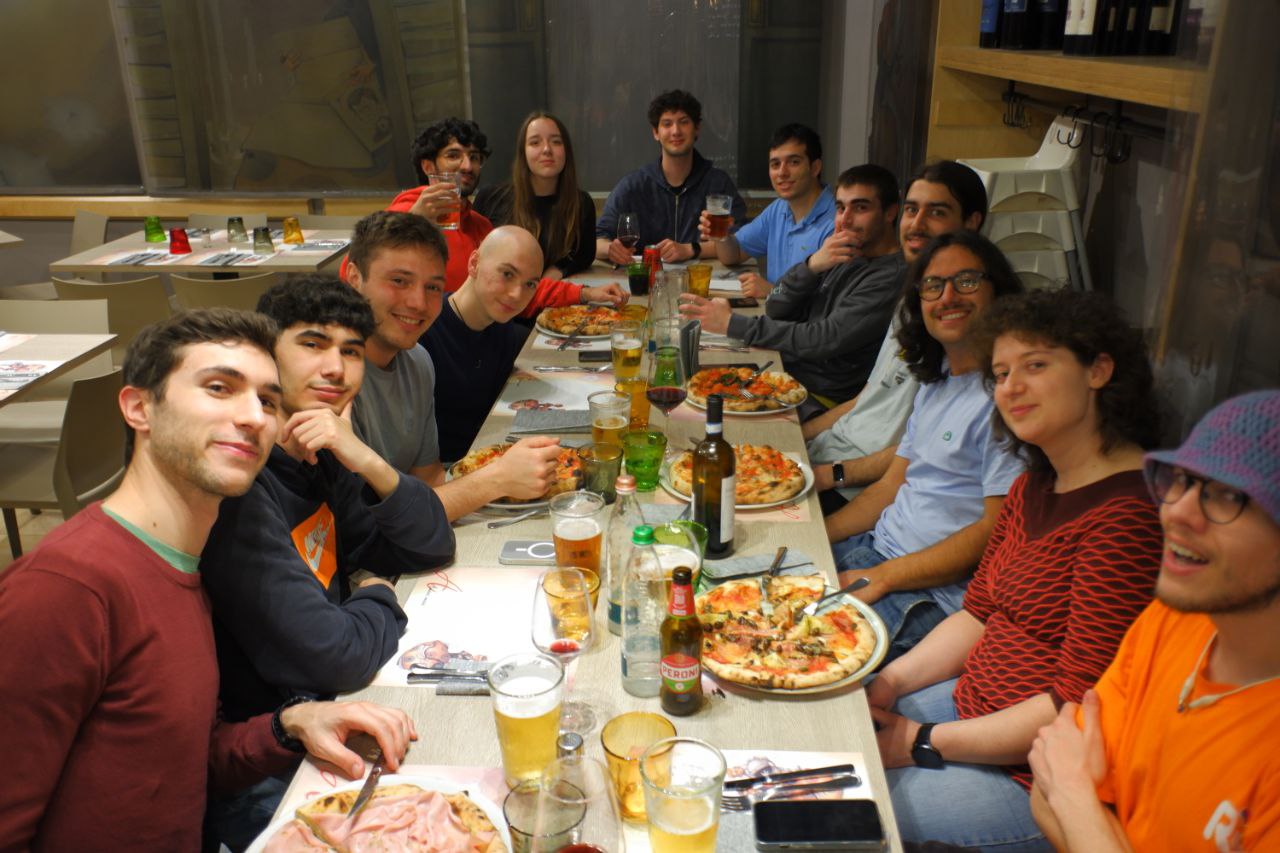
What We Do
Here are some of the exciting activities our team has been a part of.
QubiTO Quantum Seminars
June-July 2026
In June and July, three seminars dedicated to the foundations of quantum mechanics will take place, in which open problems regarding the interpretation of the theory will be discussed, such as the question of its completeness and the meaning of the wave function, while also emphasizing the formal and experimental implications that a critique of its principles entails. The seminar series will feature presentations by Prof. Marco Giovanelli, historian and philosopher of physics and associate professor of the history of philosophy at the University of Turin, Prof. Marco Genovese, director of the quantum optics center at the National Institute of Metrological Research and corresponding member of the Academy of Sciences of Turin, and Dr. Davide Romano, researcher in the philosophy of physics at the University of Verona.
📍 Politecnico di Torino 📅 June-July, 2026
ETH Quantum Hackathon 2026 in Zurich
May 2026
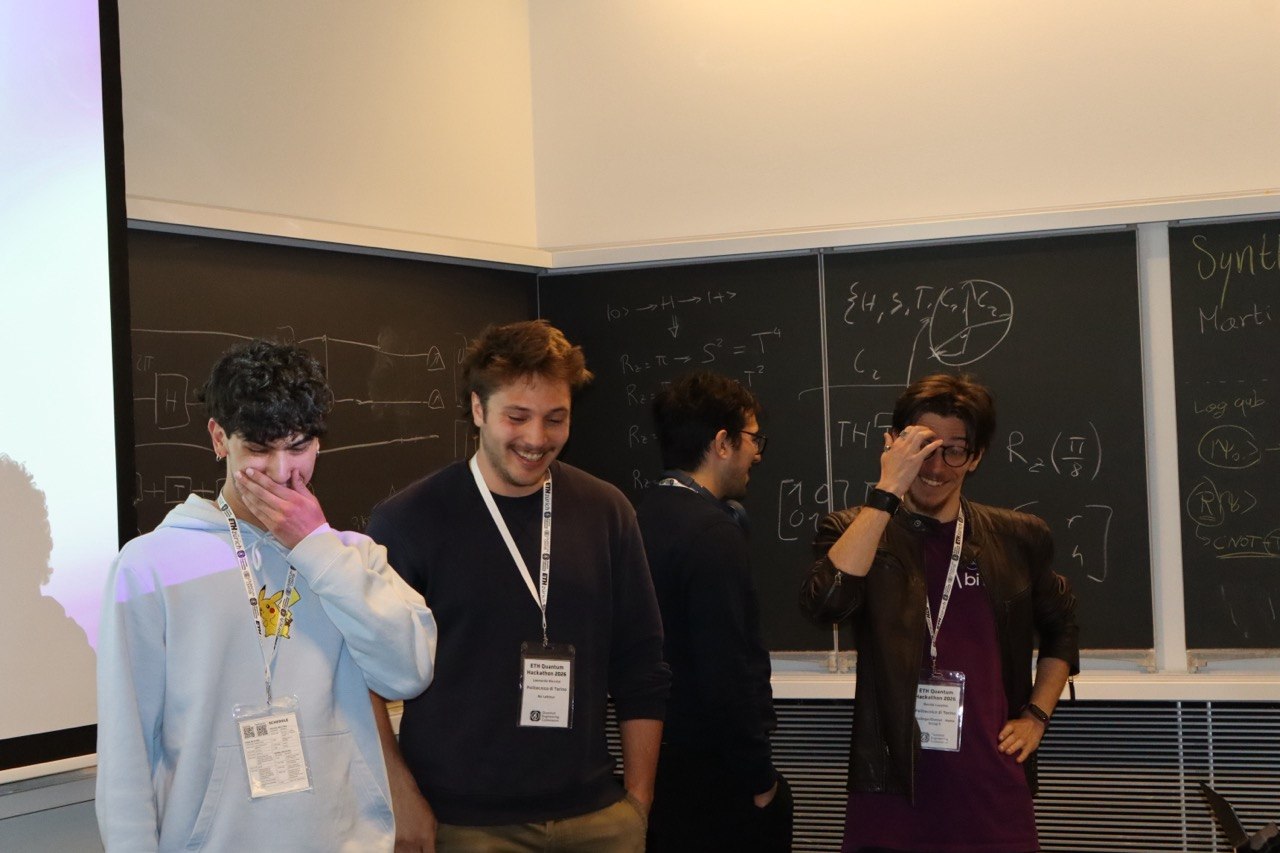
At ETH Zurich, QubiTO tackled the challenges set by QuEra and Zurich Instruments. For the QuEra challenge, where we secured third place with an honorable mention, we tackled a counterintuitive question: can a 1-qubit logic gate be harder to implement than a 2-qubit one? Diving into fault-tolerant circuit synthesis, we experienced firsthand the enormous hardware cost of non-Clifford gates, addressing one of the major hurdles for large-scale quantum computing. For the Zurich Instruments challenge, we set ourselves a crucial goal: how quickly and autonomously can a qubit be calibrated? By creating a digital twin of the system, we replaced slow brute-force sweeps with physics-guided spectroscopy and Bayesian estimation algorithms. This approach drastically reduced the required measurements, optimizing QPU machine time and taking a decisive step toward fully automated, human-free operation.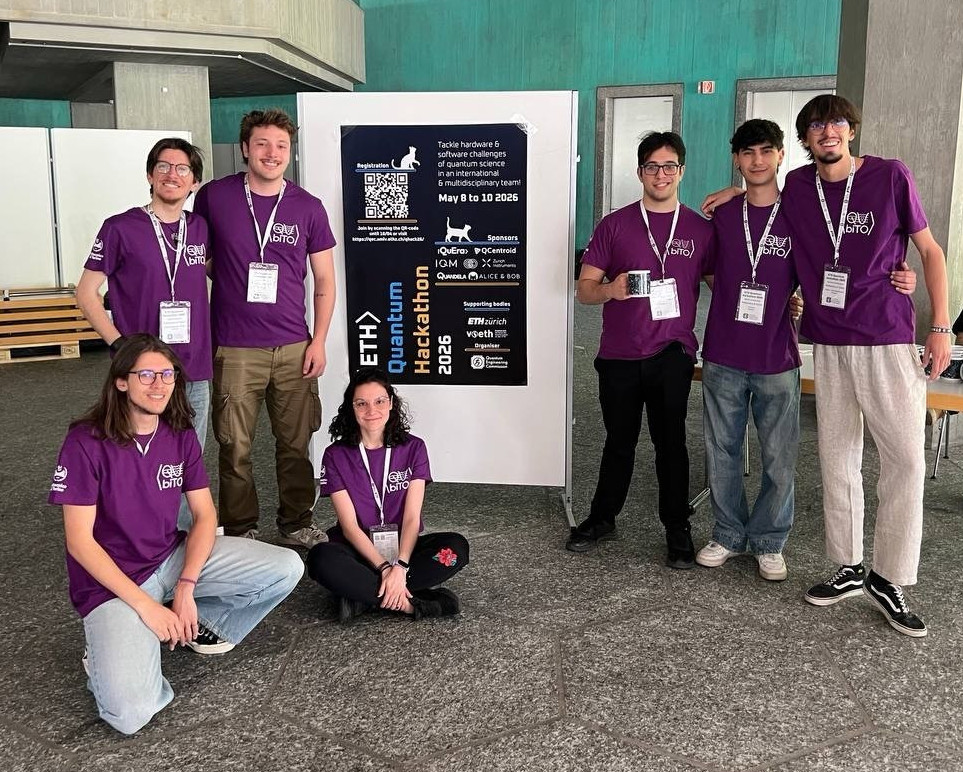
IQM Quantum Hack in Madrid
December 2025
In December, the student team QubiTO traveled to Madrid for the IQM Quantum Hack, a 24-hour quantum computing hackathon. The team tackled two major challenges: Algorithm Resolution (Indra) and Risk Prediction (Santander). For the Indra challenge, QubiTO designed and implemented a modified Monte Carlo Tree Search (MCTS) algorithm. This approach allowed the team to efficiently navigate a complex problem space within the strict 24-hour limit, earning them second place. In the Santander track, QubiTO applied quantum concepts to financial modeling, aiming to predict and mitigate risk factors more accurately and efficiently than classical computing methods.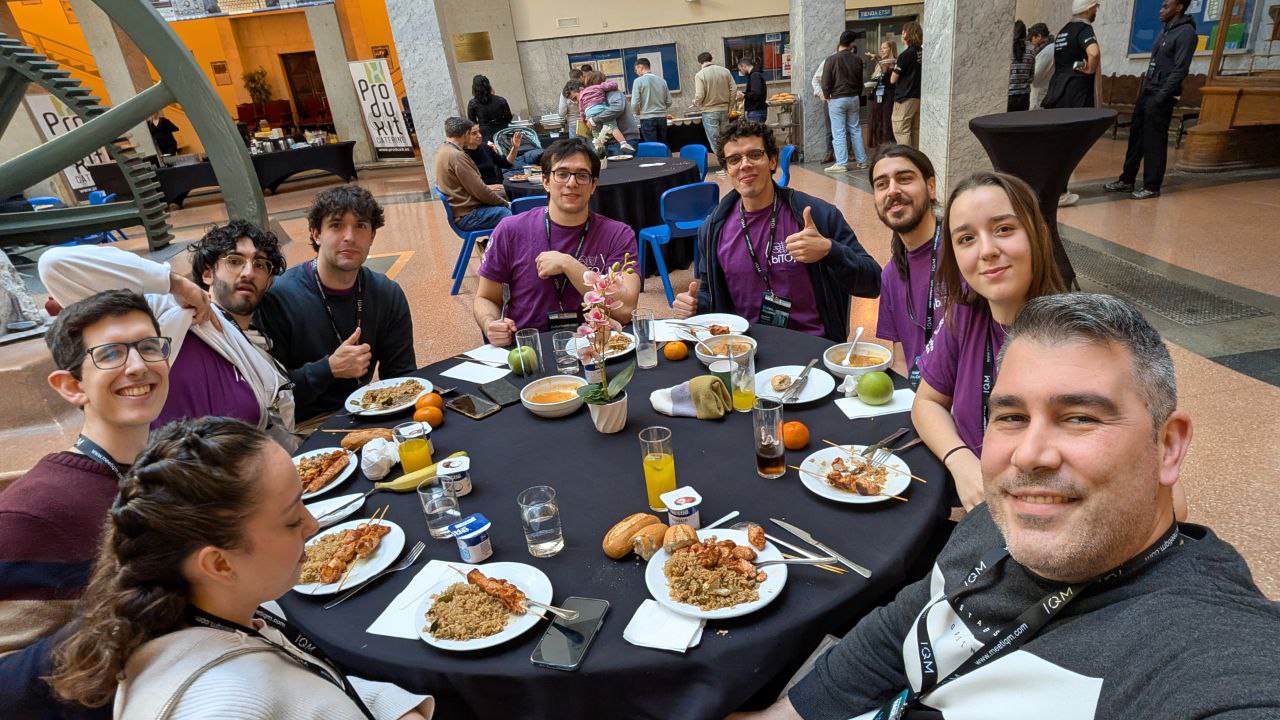
Pushquantum Hackathon in TUM Munich
November 2025
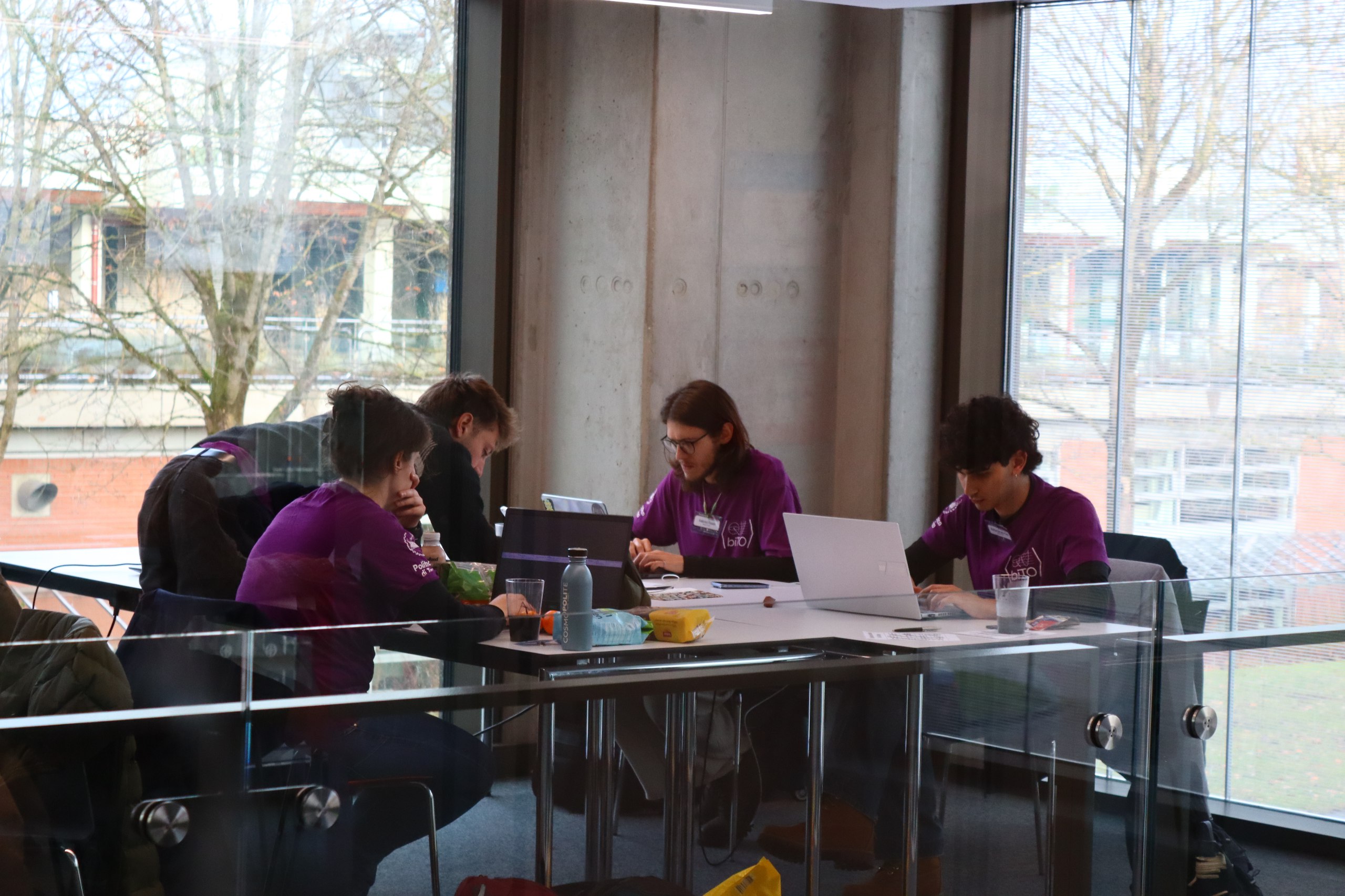
During the hackathon, our team dove into one of the biggest challenges in quantum computing: error correction. We developed a strategy to protect computations from noise, aiming to achieve the highest possible accuracy while working with extremely limited hardware resources. To find the perfect solution, the group tested and compared several algorithms: we started with standard baseline approaches, experimented with advanced mathematical optimization models, and ultimately even built our own custom solution from scratch.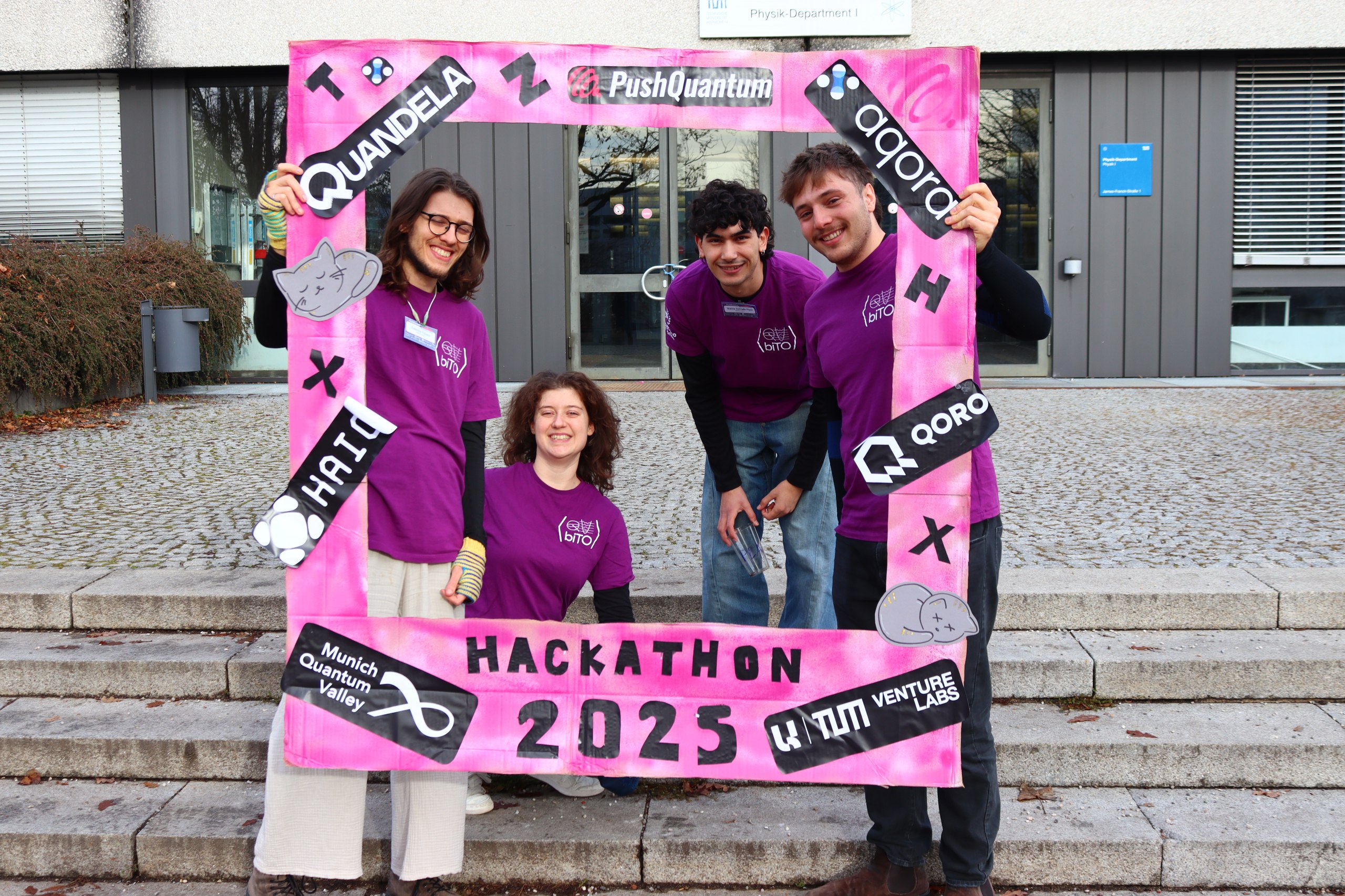
Recent
Get in Touch with Us!
If you want to support us in our mission or join us on our journey, please don't hesitate to reach out. We are always grateful for the help and encouragement from our community.